Aural Atresia Hearing Loss and Solutions: Answers to Frequently Asked Questions
If your child has been diagnosed with aural atresia, you may wonder about the impact on their hearing abilities and possible solutions. Keep reading to learn more about hearing loss related to aural atresia and devices that can help.
What is aural atresia? Does it cause hearing loss?
The human ear is made up of three parts: the inner, middle, and outer ear. The outer ear is composed of the pinna and the external auditory canal. Find out more about how hearing works here.
Aural atresia is the absence of the external auditory canal, meaning the ear canal is closed. It is commonly present with microtia (an underdeveloped or malformed pinna) or anotia (the absence of the pinna). Microtia and anotia are more visible than aural atresia, so parents sometimes worry more about how the ear looks.
However, the ear canal is critical for hearing because it guides sound waves to the eardrum and middle ear. Hearing loss can occur when the ear canal is closed, like when a child is born with aural atresia.
How or how much does my child with aural atresia hear? Why can my child still hear some sounds if the ear is “closed”?
Since hearing is a complicated process, try not to worry if you do not understand exactly how it works. You can learn more about different types of hearing loss here.
Aural atresia causes "maximal conductive hearing loss" since the ear canal is closed. This means soundwaves reach the inner ear through bone conduction instead of air conduction, which is how hearing usually works. While a middle or inner ear malformation may be present if someone has aural atresia, the inner ear and cochlear nerve usually develop healthily. In this case, a child with aural atresia would hear the “vibrations” of some moderate to loud sounds.
A comprehensive test can help determine your child's hearing loss. They will get an audiological evaluation to diagnose the type and degree of hearing loss, so you will understand what and how they hear. The impact of aural atresia on your child's hearing loss depends on whether they have it in one ear (unilateral) or both ears (bilateral).
There are also several syndromes that atresia can be part of that may affect hearing and
language development. These syndromes include Goldenhar, Treacher Collins, Crouzon, Mobius, Klippel-Feil, Fanconi, DiGeorge, De Grouchy, and branchio-oto-renal, and Pierre Robin sequence.
How do I know if my child with aural atresia has a syndrome?
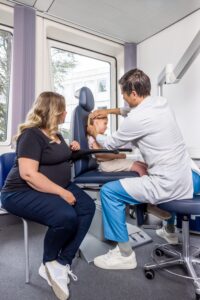
© Rolf Schulten / MED-EL
Microtia or atresia that are part of a syndrome will show up along with other physical
signs. For example, signs of Goldenhar syndrome include an underdeveloped or undeveloped
pinna, cleft lip and palate, and facial, eye, and dental problems. Treacher Collins syndrome can cause the jaws, ears, eyelids, and cheekbones to develop abnormally. With Crouzon syndrome, microtia and atresia may also be associated with other malformations of the skull and face.
An individual with a syndrome can have just a few or many symptoms. But you do not need to worry—your doctor will refer your child for a genetic evaluation if necessary.
I want my child with aural atresia to use a device for their hearing loss. Can they use a regular hearing aid?
If your child has hearing loss, a device can help them develop like their peers. However, with aural atresia, they cannot use a regular hearing aid with an earmold. Luckily, there are other devices available.
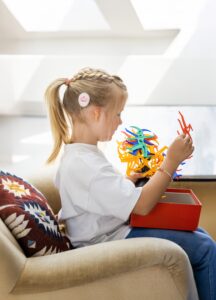
© MED-EL
Bone conduction devices can be a great solution for people with aural atresia and/or middle ear malformations who have a healthy inner ear. These devices are placed in the skull bone, usually behind the pinna. They pick up sounds from the environment and convert them into mechanical vibrations. These vibrations are then transmitted to the skull, and the bone sends them to the healthy inner ear.
When a child is born with hearing loss, it is important to treat it as soon as possible to get the best results. Non-surgical bone conduction devices with an adhesive, such as ADHEAR, can be used by babies and infants. An implantable bone conduction system like BONEBRIDGE may be an option for older children.
Another option is a middle ear implant, like the VIBRANT SOUNDBRIDGE, depending on the child’s middle ear anatomy. Unlike a bone conduction implant, a middle ear implant is placed on a middle ear structure and can stimulate each ear independently.
Both the BONEBRIDGE and VIBRANT SOUNDBRIDGE can be easily implanted with one surgery. Your ENT surgeon can determine which is the best solution for your child.
Is it important to treat unilateral hearing loss due to microtia and aural atresia?
The benefits of hearing devices in unilateral hearing loss are apparent. If fitted early enough, they can maximize their child’s hearing abilities and minimize the risk of developmental delays. Studies have shown that unilateral hearing loss can harm some children’s academic performance (1). Hearing devices not only improve the ability to hear and speak, but they also improve understanding in difficult listening situations, like classrooms or noisy environments. Greater speech understanding can reduce the effort needed to listen and free up your child’s brain power for other tasks.
Keep in mind that middle ear infections are common among children and can affect the hearing ear. In this case, a child with unilateral hearing loss may experience temporary bilateral hearing loss when they have an infection.
What are important factors to consider when choosing a non-surgical bone conduction system for my child?
- The device should be comfortable. This is because the most benefits for auditory and language development come from using it as much as possible while awake. The ADHEAR system does not have a headband, so it does not put uncomfortable pressure on the skin.
- The device should stay in a stable position to provide reliable hearing. ADHEAR does this with an adhesive adapter instead of a headband. For systems with headbands, the device can move, making sound transmission unstable. It can also be stressful for parents to adjust the headband often.
- Whether your child is or would be comfortable with the device’s appearance. As the ADHEAR system sits behind the ear and does not require a headband, it can be less noticeable and help reduce stigmatization.
- The device’s battery life: ADHEAR uses a P13 battery that lasts up to 2 weeks.
What are important factors to consider when choosing a bone conduction or middle ear implant for my child?
- The audio processor should provide all-day comfort. The SAMBA 2 audio processor, used with BONEBRIDGE and VIBRANT SOUNDBRIDGE implants does not exert pressure thanks to its low weight and the slight magnetic attraction. This maintains comfort without skin complications.
- Children need an implant that can deal with their everyday bumps. The implant should be reliable and safe.
- The BONEBRIDGE and VIBRANT SOUNDBRIDGE are placed entirely under intact, healthy
This means there are no open wounds. - The BONEBRIDGE implant is placed in the mastoid, which is the large piece of bone behind the external ear. The implant’s design and placement create minimal skin tension and stable impact resistance.
- The VIBRANT SOUNDBRIDGE has been on the market for over 25 years with a low
complication rate and proven long-term reliability. - Whether your child is or would be comfortable with the device’s appearance. The SAMBA 2 audio processor has a low profile and can be easily hidden under the hair. If the child wants to stand out, various printed covers are available to personalize the device.
- The device’s battery life: SAMBA 2 uses a P675 battery that lasts eight to 10 days.
Source: MED-EL Blog, Aural Atresia Hearing Loss and Solutions: Answers to Frequently Asked Questions.




 English
 Albanian
 Bosnian
 Bulgarian
 Croatian
 Czech
Czech Estonian
 Hungarian
 Latvian
 Lithuanian
 Macedonian
 Persian
 Romanian
 Serbian
 Slovak
 Slovenian